What is a project, really?
PMBOK® 8 rewrote the definition of a project: a temporary initiative in a unique context, undertaken to create value. That sounds like theory. It is not. Used well, the definition tells you three things: plan the end at the start, explain projects to senior management, and decide whether you need a project at all.

You will recognise this meeting. Someone calls a piece of work "a project", half of the room nods, and the other half thinks: that is just our job. Both sides are right about something, and the definition of a project is the quickest way to find out what.
Most project managers learned that definition once, for an exam, and never looked at it again. That is a pity, because it is one of the most practical tools you have.
The PMBOK definition of a project
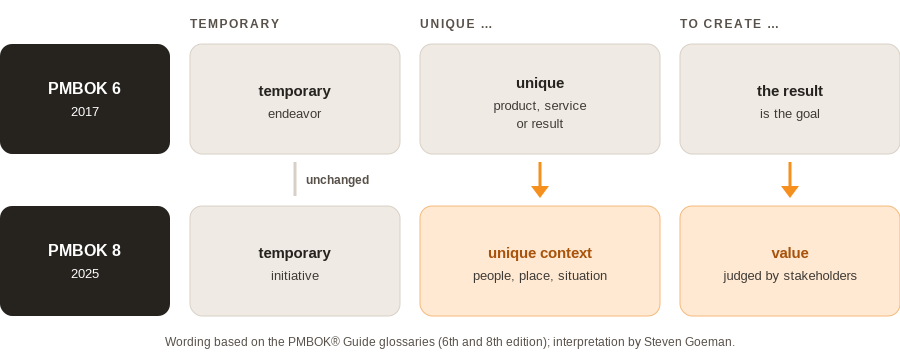
PMBOK® 8 defines a project as "a temporary initiative in a unique context undertaken to create value". The 6th edition, eight years earlier, still spoke of creating "a unique product, service, or result".
The PMBOK® Guide 6th edition (2017) defined a project as a "temporary endeavor undertaken to create a unique product, service, or result". The 8th edition (2025) puts it differently:
"A temporary initiative in a unique context undertaken to create value."
- Temporary stayed. A project has a start and an end. If the work never ends, it is operations.
- Unique moved. It no longer describes the result, but the context. A second warehouse may be a copy of the first, but the site, the team, the suppliers and the people who will work there are new.
- Value is new. The product, service or result is no longer the goal. It is the way to the goal, and PMBOK 8 now ends its definition of project management with the aim "to meet or exceed the intended value".
From those few words you can derive more than it seems. A project is temporary, it works in a context that has not existed in this combination before, and it exists to create value, which links it to the goals of the organisation. In practice it is also multidisciplinary: people from different departments work together for a while. And because it happens once, it has to be done right the first time.
Prefer to watch? In this video from 2021 I explain the concept, still with the PMBOK® 6 definition.
 Explain like the best what a project actually is (2021)
Here are three ways I use the definition in real projects.
1. Plan the end at the start
Every project ends, so the end deserves a place in the plan from day one. Before the work really starts, agree on three things:
- How the result will be handed over to the sponsor.
- Which acceptance criteria apply. They are the most concrete description of the intended value, so check them for the requirements nobody mentions.
- Who the sponsor is. The sponsor wants the result, receives its benefits and owns it once the project is closed.
A common mistake is to leave these questions for the last weeks. By then the sponsor and the future users have not been involved, the criteria are open to discussion, and the handover becomes a negotiation instead of a formality.
2. Use the definition with senior management
Many executives grew up as experienced operational managers. They know how to run a department, and that is exactly why projects can surprise them: a project needs a different way of steering.
In one of the first steering group meetings, I show the definition and put the characteristics of a project next to those of operations: temporary versus ongoing, unique versus repetitive, a temporary team from several departments versus a stable line organisation. That short conversation explains why a project needs a sponsor who decides, a plan with an end date and a project manager with a mandate, and it makes the request for those resources a logical step instead of a demand.
3. Decide whether you need a project at all
Not every initiative called a project is one.
- Repetitive work belongs in an operational process. Running it as a project adds overhead and never ends.
- A one-time quick fix can often be done ad hoc, by the people who already do the work.
- A real project delivers a new, structural solution by a due date, in a context that is new, and it has enough substance to justify project management.
To judge that substance, I use eight criteria in my courses: project size, fields of expertise, project duration, schedule and cost tightness, number of stakeholders, governance complexity, innovation and project remoteness. Score each from 0 to 3. The higher the total, the more the initiative leans towards a project. A small company may reach that point sooner than a large one, and that is fine. What matters is that the line is drawn on purpose, before the work starts, because that decision sets how the work will be led, funded and judged.
You will find both tests, project or operations and the eight criteria, in the free checklist below.
Before you start your next initiative, first ask whether it is a project at all.
Want everyone to mean the same thing by "project"?
A Practical Introduction to Project Management gives new project managers a clear start, beginning with what a project is and what it is not. Sponsors and steering committee members get the same shared language in the Executive Workshop, because a project that the sponsor sees differently is already off track.
Sources
- Project Management Institute (2025). A Guide to the Project Management Body of Knowledge (PMBOK® Guide), 8th edition. Glossary: project, project management, p. 271.
- Project Management Institute (2017). A Guide to the Project Management Body of Knowledge (PMBOK® Guide), 6th edition. Section 1.2.1 Projects, p. 4.
Steven Goeman is a PMP® and NLP Master Practitioner, guest professor at Thomas More, and has over 30 years of experience in and around projects. An earlier version of this article appeared on gaps.be.