Skip to content
The 8 Project Manager Types

What type of project manager am I?

Everyone is called a project manager, but the title describes only one of eight types. And everyone working on a project manages something, at least their own part of the work. Your type depends on three things: where you work, what you do and how big it is.

You see your type straight away. Your personal report then shows your mandate, your sources of influence, what gives you energy and how you communicate best, and it comes only to you.

FOCUSFIELDSCALE
The 8 Project Manager Types

Which roles do project management?

Each type has its own stakeholders, its own expectations to manage and its own blind spots. Click a type to read its full profile.

Notice what happens when someone is called a "project manager". A project manager is someone who mainly carries out project management activities, and that is not a title or a function. Many roles carry out such activities and are therefore called project managers, while their work in practice mainly asks for something else. That is how expectations are already off before the project starts.

And that is exactly the primary task of anyone with project management in their job: managing expectations by communicating enough with the right stakeholders. Your type helps you get those expectations clear, including about yourself: it describes what your role asks of you today, not who you are.

Three axes

What determines your type?

Field

In-houseClient-facing

In-house: the project delivers for internal clients only; its "contract" is the business case or project charter. Client-facing: the project delivers for an external (end) client, under a commercial contract.

In-house

Hierarchy, informal influence, competing priorities, no commercial contract. Typical trap: Assumes shared context; no explicit agreements.

Client-facing

Contract, scope, two organisations, commercial tension. Typical trap: Overpromising or defensive contract-speak; forgets the second front (your own organisation).
Focus

ExpertiseOrchestration

Do you mainly contribute content yourself, or organise and steer the work of others?

Expertise

Credibility through content; peer-to-peer, technical. Typical trap: Assumes the content speaks for itself; doesn't translate for non-experts.

Orchestration

Credibility through overview and reliability; aligning people. Typical trap: Generic status reporting; loses touch with the content.

Scale

ContainedExtended

How many teams, organisations, decision levels and stakeholders are involved? In a contained project the expert often leads it; in an extended project the expert becomes a team member. A large project and a programme (several related projects) score the same here: the model does not separate them.

Contained

Direct, oral, informal, interactive. Typical trap: Nothing written down; expectations stay implicit.

Extended

Formal, layered, push and pull; communicating through others. Typical trap: Report flood; message distortion across layers; "the plan is the communication".

Influence without mandate

Responsible, but without the mandate?

Notice how often you are responsible for a project while the team reports to someone else and every expense goes through the line. That does not mean you are without influence: your influence then rests on who you know, what you know and how people see you. The scan shows how much mandate your role needs, and which sources of influence you can build most easily.

Five ways to increase your influence as a project manager

  1. NetworkYou know the right people, and you bring them together around a goal at the right moment.
  2. ExpertisePeople follow you because you master the content.
  3. InformationYou know what others don't know yet, and you share it at the right moment.
  4. TrustPeople follow you because they respect you and count on you.
  5. Your formal positionPeople follow you because your position allows it: you can offer recognition, opportunities or resources, or impose (negative) consequences.

You can always build the first four yourself, even with little mandate. The fifth is usually out of your own hands.

Based on French and Raven (1959) and Raven (1965). Grouping and ranking: The Project Management Mentor.

The common thread

Every type communicates

Communication is not a separate activity. The moment there is one other person involved, and there always is (a line manager, a project sponsor, a client), communication is needed. Every project delivers something to someone. That is why communication runs through all four activities in your profile.

Everyone who works for an organisation has a permanent function: the job you were hired for. A project role is temporary: you are assigned to it when you join a project, and it ends when the project ends. In project careers your function and your role are often the same, but not always. Even a full-time project manager can be a team member on someone else's project, for example in the rollout of new project management software.

Your growth story

What gives you energy?

Before you choose your next step, it helps to know where your energy is heading. Your answers show where you stand now, which role and which sources of influence give you energy, and which step comes first. That way you naturally grow in the direction that suits you.

1Where you stand now
2Where your energy is heading
3What you need
4Your next step
Career path

How do you grow?

You can grow along a management path or an expert path, and in three tracks: purely operational, operational with a project component (hybrid), or purely project-based. In the hybrid track you mostly stay in the expert roles.

Each cell shows the function and, after the arrow, the project role that usually goes with it. Your career stage is not your age: every switch starts a new cycle.

Exploration15-24Establishment: trial25-30Establishment: advancement31-44Maintenance45-64Disengagement65+
Operational · ExpertFirst operational jobDepartment collaboratorExperienced department collaboratorSenior specialistCompetence Center collaborator
Operational · ManagementFirst operational jobDepartment collaboratorDepartment managerStaff / executive managerExecutive coach
Hybrid · ExpertDepartment collaborator → Project Team MemberDepartment collaborator → Project Team MemberExperienced department collaborator → Expert Project Lead (Project Team Member on large projects)Senior specialist → Project Team Member/Expert Project Lead (go-to expert for projects)Competence Center collaborator
Hybrid · ManagementDepartment collaborator → Project Team MemberTeam lead → Expert Project Lead or Project Manager (part-time)Department manager → Project Manager (part-time) → Corporate PMO collaboratorHead of Corporate PMO / Executive manager (project sponsor or project director)Executive coach / Competence Center / Corporate PMO
Project in-house · ManagementProject Team MemberProject ManagerCorporate Project Manager / Corporate PMO collaboratorProgramme / portfolio manager / Head of Corporate PMOExecutive coach / Competence Center / Corporate PMO
Project client-facing · ExpertProject ConsultantSenior Project Consultant → Project ConsultantLead ConsultantLead Consultant / freelancerSenior advisor / Competence Center
Project client-facing · ManagementProject ConsultantClient Project ManagerAccount Project ManagerDelivery or business unit directorExecutive coach / Competence Center

Typical switches between tracks

Project Manager ⇄ department manager, and Corporate PM ⇄ staff manager: from project to line and back.

The consultant who joins the client: Project Consultant/Lead Consultant → Project Team Member/Expert Project Lead, or Client Project Manager/Account Project Manager → Project Manager/Corporate Project Manager.

Back from a management role to an expert role, typically in the second half of Maintenance. Not a step back, but a deliberate switch that starts a new cycle.

The career stages follow Donald Super's life-span model. Ages are typical, not prescriptive: every career switch starts a new cycle, and career maturity does not always match age. Super's career stages (Life-Span, Life-Space theory); dual career ladder (management and expert path).

Which project manager are you?

About 7 minutes. You see your result immediately, without leaving your email address.

What you get

A personal report

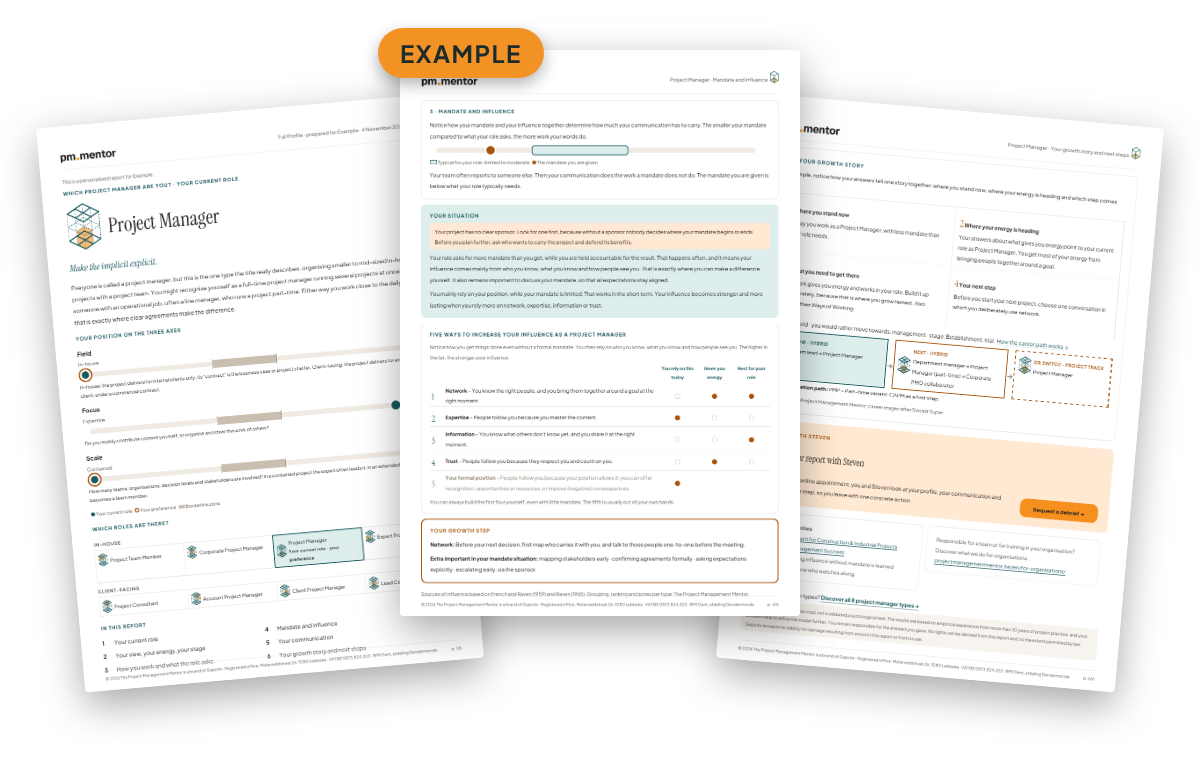
You see your type straight away on screen. If you want more, you get a personal 6-page report, and it comes only to you.

In the report

  • how you spend your project time compared with your role
  • your Talent Triangle profile
  • your mandate and your sources of influence
  • your communication habits and your communication advice
  • your growth story: where your energy is heading and your next step
Example of three pages of a personal report for a Project Manager
Example of a personal report. Download the example report (PDF) →
For HR and line managers

Looking for a project manager? First know which one.

Many vacancies ask for "a project manager", while the project needs a very different type. Up to seventeen questions about your project show which type fits.

This is a reflection tool, not a validated psychological test. The results are based on more than 30 years of practical project experience, and your answers help to refine the model further. You remain responsible for the answers you gave. No rights can be derived from this report and, to the extent permitted by law, The Project Management Mentor (Gaps bv) accepts no liability for damage resulting from errors in this report or from its use.