Six strong candidates
They all have a certificate and a strong CV. And still nobody on the panel knows which one is right.
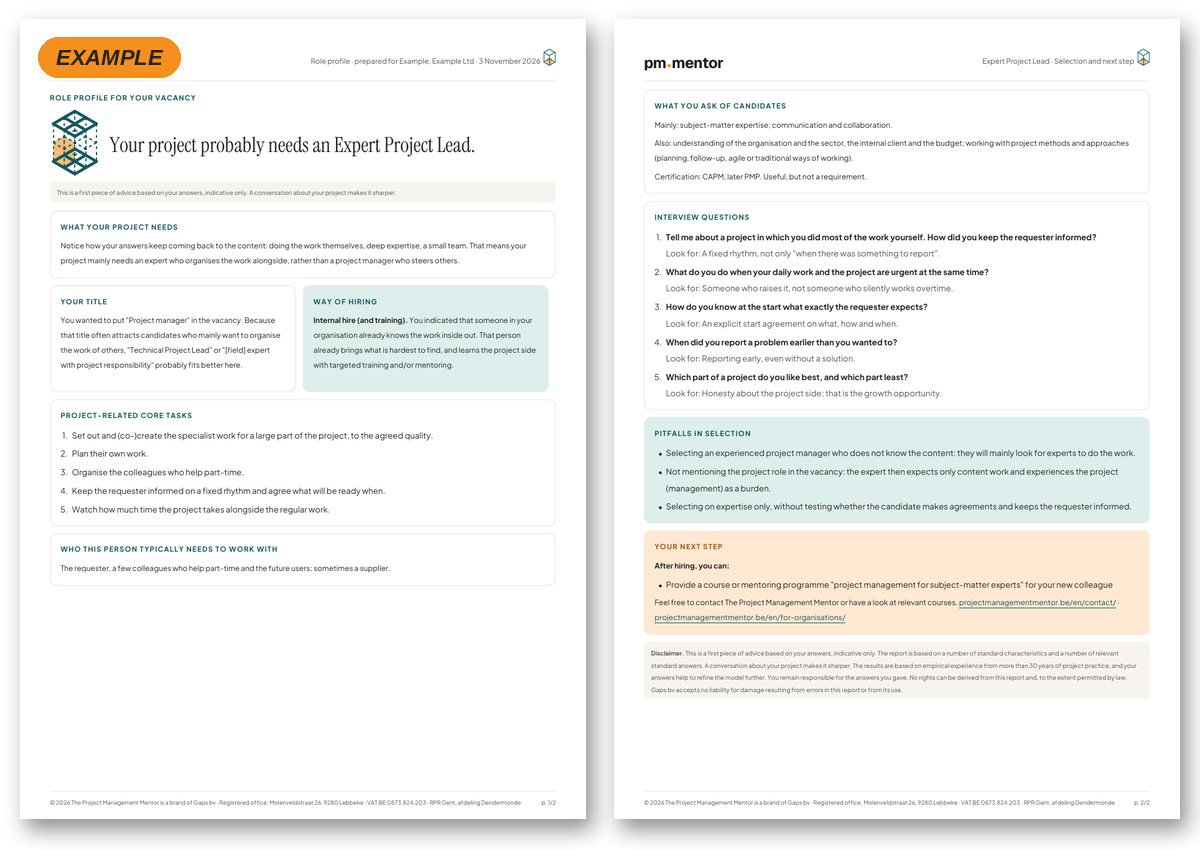
Behind the title "project manager" sit eight different roles. Answer up to 17 questions about your project, and you discover which role you are really looking for. You immediately get a role profile with core tasks, skills, the mandate the role needs and interview questions for your vacancy.
They all have a certificate and a strong CV. And still nobody on the panel knows which one is right.
The line manager says once more that the candidate is not a fit. Ask why, and the answer stays vague.
The new project manager leaves after a few months. The job turned out to be different from what the vacancy said, or the mandate was missing.
Often it is not the candidates, but a question nobody asked beforehand: which project manager does this project need? Once you know, every conversation with a candidate becomes sharper.
Each type calls for different tasks, different skills and different interview questions. The scan points you to the type that fits your project.
Notice what happens when you hire a project manager without a budget or a team of their own: you are then asking for someone who mainly works through influence. That means the role asks for more experience than the title suggests. The scan compares the mandate the organisation gives with what the role needs, and translates it into the skills you are looking for.
You can always build the first four yourself, even with little mandate. The fifth is usually out of your own hands.
Based on French and Raven (1959) and Raven (1965). Grouping and ranking: The Project Management Mentor.
Hiring a project manager is also a career choice, for your organisation and for the candidate. The table shows which tracks exist, from specialist to Corporate PMO, and how people move from one track to another. It also shows which talent you may already have in-house.
Each cell shows the function and, after the arrow, the project role that usually goes with it. Your career stage is not your age: every switch starts a new cycle.
| Exploration15-24 | Establishment: trial25-30 | Establishment: advancement31-44 | Maintenance45-64 | Disengagement65+ | |
|---|---|---|---|---|---|
| Operational · Expert | First operational job | Department collaborator | Experienced department collaborator | Senior specialist | Competence Center collaborator |
| Operational · Management | First operational job | Department collaborator | Department manager | Staff / executive manager | Executive coach |
| Hybrid · Expert | Department collaborator → Project Team Member | Department collaborator → Project Team Member | Experienced department collaborator → Expert Project Lead (Project Team Member on large projects) | Senior specialist → Project Team Member/Expert Project Lead (go-to expert for projects) | Competence Center collaborator |
| Hybrid · Management | Department collaborator → Project Team Member | Team lead → Expert Project Lead or Project Manager (part-time) | Department manager → Project Manager (part-time) → Corporate PMO collaborator | Head of Corporate PMO / Executive manager (project sponsor or project director) | Executive coach / Competence Center / Corporate PMO |
| Project in-house · Management | Project Team Member | Project Manager | Corporate Project Manager / Corporate PMO collaborator | Programme / portfolio manager / Head of Corporate PMO | Executive coach / Competence Center / Corporate PMO |
| Project client-facing · Expert | Project Consultant | Senior Project Consultant → Project Consultant | Lead Consultant | Lead Consultant / freelancer | Senior advisor / Competence Center |
| Project client-facing · Management | Project Consultant | Client Project Manager | Account Project Manager | Delivery or business unit director | Executive coach / Competence Center |
Project Manager ⇄ department manager, and Corporate PM ⇄ staff manager: from project to line and back.
The consultant who joins the client: Project Consultant/Lead Consultant → Project Team Member/Expert Project Lead, or Client Project Manager/Account Project Manager → Project Manager/Corporate Project Manager.
Back from a management role to an expert role, typically in the second half of Maintenance. Not a step back, but a deliberate switch that starts a new cycle.
The career stages follow Donald Super's life-span model. Ages are typical, not prescriptive: every career switch starts a new cycle, and career maturity does not always match age. Super's career stages (Life-Span, Life-Space theory); dual career ladder (management and expert path).
Up to 17 questions about your project and your organisation, without jargon. Free, and you describe a role, not a candidate.
You describe your project, not a candidate: you are not asked for any personal data. On screen you immediately see the type, advice on the title in your vacancy, the way of hiring that fits and the next step. If you want more, you receive the full role profile as a PDF.
In the role profile
The Project Management Mentor reviews your vacancy, helps you screen candidates, and supports your new project manager with targeted training or onboarding mentoring.
Discover which type you are, how you communicate with your stakeholders and which career step fits you.
This is a first piece of advice based on your answers, indicative only. The report is based on a number of standard characteristics and a number of relevant standard answers. A conversation about your project makes it sharper. The results are based on more than 30 years of practical project experience, and your answers help to refine the model further. You remain responsible for the answers you gave. No rights can be derived from this report and, to the extent permitted by law, The Project Management Mentor (Gaps bv) accepts no liability for damage resulting from errors in this report or from its use.