Two ladders, one career
In many organisations, the only way to grow seems to be to manage. So the best expert becomes the project manager, often without asking for it. Here is a broader view of project careers: two ladders, three tracks, and why switching between them is growth, not failure.

Notice who becomes the project manager in your organisation. Very often it is the best expert in the team: the engineer everyone asks, the analyst who knows the system by heart. Their reward for being good at the content is a job without content.
Sometimes that works. Often it does not. The organisation loses a good expert and gains a manager who is struggling, or who never wanted the job in the first place.
How I became a project manager without asking
My own career started that way. I came from accounting and ERP systems, and I joined projects as a functional consultant for the financial modules. I was a team member, there for my content knowledge.
Somewhere along the way, people saw some talent for organising, and I was "automatically" pushed into the project manager role. I had not asked for it. It just happened.
I am not the exception. The best-known study looked at sales teams in more than 200 American firms, because there performance is easy to measure. Companies promoted their best salespeople, and the better the salesperson, the worse they did as a manager. Sales is not project work, but the pattern will sound familiar to anyone who has seen a top engineer become a project manager.
And it is not only a project management problem. The same happens in the line: the best technician becomes team lead, the best accountant becomes head of finance. The skills that make you a great expert are not the skills that make you a good manager, whether you manage a project or a department.
Your function is not your role
To see a career clearly, separate two things.
- Your function is the job your organisation gives you: what is on your contract and your business card. It is permanent, until you change jobs.
- Your role is what you do in a specific project. It is temporary and can change from one project to the next.
A full-time project manager can be a team member in a project that rolls out new project management software. A department manager can lead a small project next to the daily work. Function and role do not have to match, and that is normal. If you want to know which of the eight project roles you have now, the model behind the free scan describes them.
Two ladders, three tracks
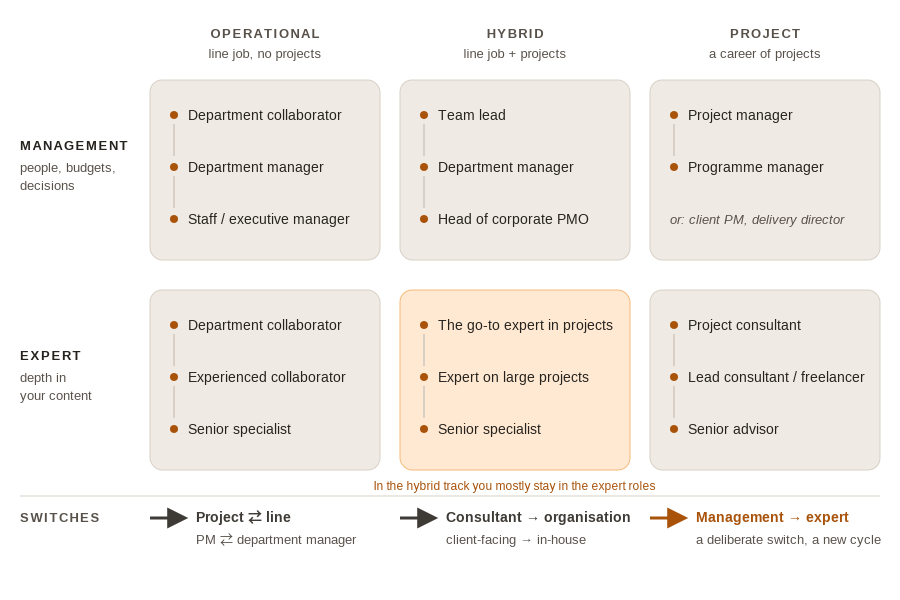
A career can grow along two paths:
- The management path: you take responsibility for people, budgets and decisions.
- The expert path: you go deeper into your content, and others rely on your knowledge.
And it can run in three tracks:
- Operational: a line job without projects.
- Hybrid: a line job with a project component. Here you mostly stay in the expert roles, as the go-to expert for projects.
- Project: a career made of projects, either in-house or for external clients.
What is a dual career ladder?
A dual career ladder lets people grow either as a manager or as an expert, with equal pay, title and recognition on both ladders. In practice, the expert ladder often stays on paper.
The idea of a dual career ladder is not new. By the 1980s, engineering organisations had already installed technical ladders next to their management ladders. Almost twenty years ago I wrote my MBA thesis on project management career paths, and the problem I found then has not gone away: the expert ladder rarely has the same value as the management ladder. A promotion "sideways" does not feel like a promotion.
In many organisations the dual path does not even exist formally. Promoting a good technician to project manager is then the only way to give them a raise. That is how the drama starts: a good technician lost, a reluctant manager created, and nobody asked whether the person could or even wanted to manage. I once recorded exactly this in the lessons learned register of a large project I managed.
It often creates a second misunderstanding as well. The technician who becomes project manager holds on to what made them strong: their technical knowledge. They start to believe that project management is content work, and they pass that belief on to everyone around them. Before long, the whole organisation thinks a good project manager is simply the best technician on the team. That is one of the reasons why so many different types of project managers exist side by side, often without knowing it.
For HR, the lesson is simple to say and hard to do: make both ladders equal in pay, title and recognition, and describe roles, not only functions.
Switching is growth too
Careers rarely follow one ladder from bottom to top. They switch:
- From project to line and back. A project manager becomes a department manager, a corporate project manager becomes a staff manager, and some return.
- From consultant to client. The consultant who joins the client often moves from a client-facing role to its in-house mirror.
- From management back to expert. Many people make this switch in the second half of their career. It is not a step back, but a deliberate choice.
I made some of these switches myself. I once moved to an operational HR role for a short time, and soon saw that a project role suited me better. I also mentored someone who moved from operational management into project management.
Today I am making the last switch. I have seen managing, and I feel the need to go back to the content path: not only doing the work, but going deeper into it. That may also have to do with my career stage. In Donald Super's career model, every switch starts a new cycle of exploring, establishing and maintaining, whatever your age.
Before you accept, or offer, the next promotion, first ask which ladder it climbs.
Which ladder are you on?
Find out which type of project manager you are today, and which career steps make sense from there. The scan takes about seven minutes and is free.
Do your ladders have equal value?
Let your project managers take the scan, and see which roles and career steps exist in your organisation. It is a first step towards describing roles, not only functions.
Sources
- Benson, A., Li, D., & Shue, K. (2019). Promotions and the Peter Principle. The Quarterly Journal of Economics, 134(4), 2085–2134.
- Hall, D. T. (1985). Project work as an antidote to career plateauing in a declining engineering organization. Human Resource Management, 24(3).
- Super, D. E. (1980). A life-span, life-space approach to career development. Journal of Vocational Behavior, 16(3), 282–298.
- Goeman, S. (2007). The Project Manager's Career Path [MBA dissertation]. Warwick Business School.
Steven Goeman is a PMP® and NLP Master Practitioner, guest professor at Thomas More, and has over 30 years of experience in and around projects.