Where did communication go in PMBOK 8?
Look for communication in the seven performance domains of PMBOK 8 and you will not find it. It did not disappear. It moved into the Stakeholders domain, and that move says a lot about what project management really is. The first article in a series on project communication.

Open the PMBOK® Guide, 8th edition, and look at its seven performance domains: Governance, Scope, Schedule, Finance, Stakeholders, Resources and Risk. You will notice that something is missing. In a profession where communication fills most of the project manager's day, there is no communications domain.
So where did it go?
Three editions, three answers
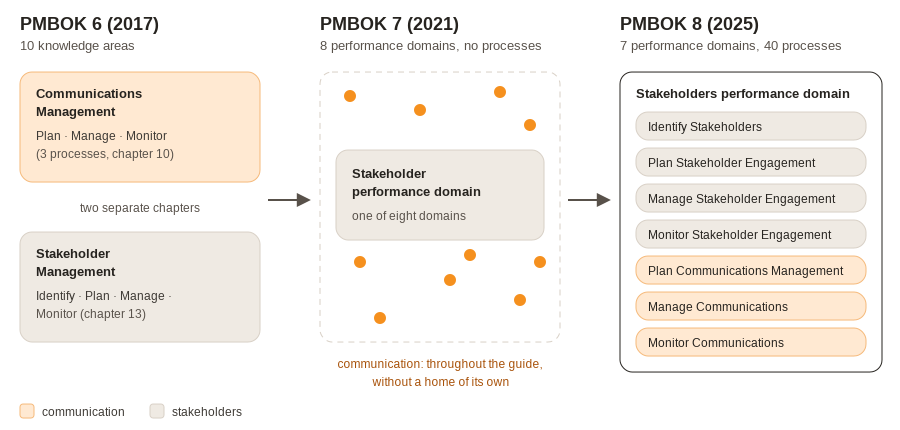
- PMBOK 6 (2017) had ten knowledge areas. Project Communications Management was one of them, with three processes: Plan Communications Management, Manage Communications and Monitor Communications. Project Stakeholder Management was a separate knowledge area, three chapters later.
- PMBOK 7 (2021) dropped the processes and introduced eight performance domains. Stakeholders became a domain. Communication did not: it ran through the whole guide, without a home of its own.
- PMBOK 8 (2025) brings back the processes, 40 of them, organised in seven performance domains and grouped in five focus areas that are not phases. The three communication processes are back too, with the same names as in 2017. But they no longer have a chapter of their own. They sit in the Stakeholders Performance Domain.
Not gone, but moved
PMI describes the Stakeholders domain as "closely linked to communications management". And it adds: "Communications management is a crucial concept for keeping stakeholders engaged."
That is not a demotion. It means communication now sits next to the people it is for. In PMBOK 6 you could plan your communication in one chapter and analyse your stakeholders in another, as if they were two different jobs. In practice they never were. You do not communicate with "the project". You communicate with people: a sponsor who wants certainty, a user who fears the change, a supplier who needs a decision by Friday.
Why I welcome this
For years now I have used my own definition of project management: providing sufficient communication to the right stakeholders to manage their expectations.
Stakeholders and communication in one sentence, because one does not work without the other. PMBOK 8 now puts them in one domain.
The same domain says that interpersonal and leadership skills are "just as important, if not more so" than technical skills. And it calls an active sponsor a critical success factor. Both come back in almost every project in trouble that I am asked to look at.
What this means for your projects
- Start with people, not with channels. A communication plan that starts from a list of meetings and reports is a plan for the project. A plan that starts from stakeholders and their expectations is a plan for the people who decide whether your project succeeds.
- Treat communication as work, not as overhead. Plan it, do it, and check whether it lands. PMBOK 8 still has a process for each of those steps.
- Read the missing domain for what it is. Communication now sits in the domain about people. That means every conversation with a stakeholder is communication work.
Before you write your next communication plan, first list the people who decide whether your project succeeds.
The series on project communication
This article opens a series on project communication. Each article starts from a part of PMBOK 8 and translates it into practice:
- Where to find your stakeholders (Identify Stakeholders)
- Who needs what, when and how? (Plan Communications Management)
- Status reports that get read (Manage Communications)
- Is your message landing? (Monitor Communications)
- Your sponsor is your most important stakeholder
- Soft skills aren't soft
Want your communication to reach the right people?
Because you communicate with people, not with a project, mentoring works on both: your project and the way you communicate in it, with your sponsor, your team and the stakeholders you have not found yet. Prefer to learn together with your team? Boost Project Management Success puts stakeholders, scope and meetings at the centre.
Sources
- Project Management Institute (2025). A Guide to the Project Management Body of Knowledge (PMBOK® Guide), 8th edition. Section 2.5 Stakeholders Performance Domain, p. 67–70; Table 2-1, p. 9.
- Project Management Institute (2021). A Guide to the Project Management Body of Knowledge (PMBOK® Guide), 7th edition. Section 2.1 Stakeholder Performance Domain.
- Project Management Institute (2017). A Guide to the Project Management Body of Knowledge (PMBOK® Guide), 6th edition. Chapter 10 Project Communications Management; Chapter 13 Project Stakeholder Management.
Steven Goeman is a PMP® and NLP Master Practitioner, guest professor at Thomas More, and has over 30 years of experience in and around projects.