One title, eight jobs
"We need a project manager" can mean eight different jobs. Three questions tell them apart: who is the project for, what do you mainly bring, and how far does it reach? Here is the model behind the free scan, and why your type says something about your role, not about you.

Notice what happens when someone says "we need a project manager". Everyone in the room nods, and everyone pictures a different person. One expects a hands-on expert who does half of the work. Another expects someone who orchestrates five teams and never touches the content. The title is the same. The job is not.
I have been asked many times to join a project as "the project manager", only to find that the client expected something else. That gap says nothing about the person. It means one title covers several roles.
Three questions that separate the jobs
- Field: who is the project for? In-house means your own organisation, where a business case or project charter acts as the contract. Client-facing means an external client, with a commercial contract.
- Focus: what do you mainly bring? With expertise, you do or advise on the content yourself. With orchestration, you organise the work of others. When more than half of your project time goes to content, your focus is expertise.
- Scale: how far does it reach? Contained means one team and few decision levels. Extended means several teams, organisations or decision levels, and many stakeholders. Programmes sit at the far end of this scale.
Complexity is not one of the three. A small, innovative project can be full of uncertainty and still be contained.
What are the 8 types of project managers?
The eight types are: Project Team Member, Expert Project Lead, Project Manager, Corporate Project Manager, Project Consultant, Lead Consultant, Client Project Manager and Account Project Manager. Three questions with two answers each give these eight combinations.
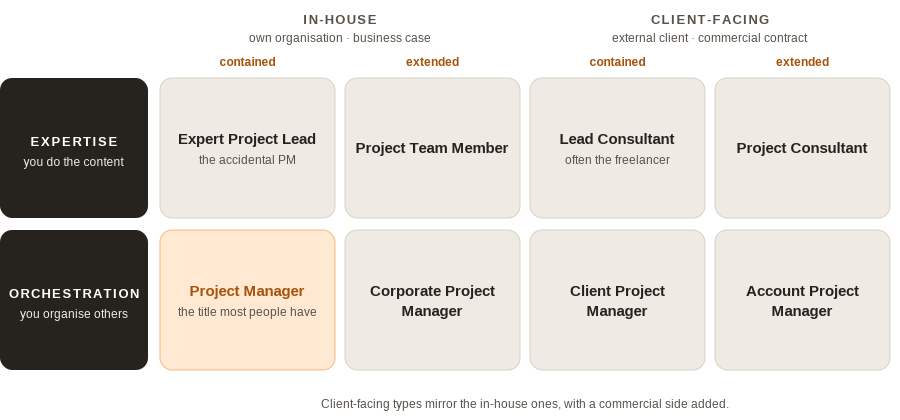
- In-house, expertise. On a small project the expert often leads it: the Expert Project Lead, also known as the accidental project manager. On a large project the same expert becomes a Project Team Member.
- In-house, orchestration. The Project Manager runs a contained project, often next to other projects or an operational role. The Corporate Project Manager steers a large one across departments, and in large organisations may also manage a programme.
- Client-facing. These four mirror the in-house types, with a commercial side added: the Lead Consultant (often a freelancer), the Project Consultant, the Client Project Manager and the Account Project Manager, also known as a delivery manager.
Only one of the eight is called "Project Manager", and that is on purpose. It is the title most people have, and it describes just one of the jobs behind it.
"But is that still project management?"
I sometimes hear people say that a team member or a consultant is not a project manager. That is a fair point if project management means a role with that title on the organisation chart.
My own definition is different: project management is providing sufficient communication to the right stakeholders to manage their expectations. By that definition, everyone in a project manages something, at least their own work and the expectations of the people who depend on it. What differs per type is whose expectations, and how far they reach.
Same title, different communication
That is why the model is first of all about communication.
- The Expert Project Lead answers to a requester and works with a few colleagues who help part-time. Communication can feel like an interruption of the real work, while it is part of it.
- The Project Manager often reports to a sponsor who is also their own line manager. "We see each other every day" can lead to unspoken assumptions, and to a yes in the corridor.
- The Account Project Manager manages expectations on two sides: the client, and their own company, which expects a margin. A significant part of their project time goes to commercial and account work.
A communication approach that works for one type can miss the point for another. Knowing your type tells you whose expectations come first.
A role, not an identity
People tend to link who they are to their job title. So when the answers point to another type, it can feel personal. It is not.
Your type describes your current role, not who you are. Roles change, and what you can do, you take with you. The first scan results show that most people expected a different type than the one their answers pointed to. That difference is often the most useful part of the result.
Before your next project starts, first find out which of the eight jobs it really asks for, and whether that is the job you think you have.
Which of the eight are you?
The free scan places you on the three dimensions in about seven minutes and shows your type right away, without an email address. Want to keep your result? The 6-page Full Profile adds your possible blind spots in communication and a next career step.
Sources
- Goeman, S. (2026). Which project manager are you? The 8 project manager types. projectmanagementmentor.be. Model based on more than 30 years of project practice; a reflection tool, not a validated test.
Steven Goeman is a PMP® and NLP Master Practitioner, guest professor at Thomas More, and has over 30 years of experience in and around projects.