Focus areas in PMBOK 8 are not project phases.
The PMBOK® Guide 8th edition renamed the process groups to focus areas. The five names stayed the same, and so did a common mistake: using them as the phases of your project. PMBOK 8 now warns against it explicitly. Here is why it matters, and what to use instead.

Look at the last project plan you received. Chances are the life cycle on the first slide reads: Initiating, Planning, Executing, Monitoring and Controlling, Closing. It looks professional, it comes straight from the PMBOK® Guide, and it quietly sends your stakeholders the wrong message.
From process groups to focus areas
In earlier editions, PMI grouped its processes into five process groups. The 8th edition (2025) calls them Project Management Focus Areas. The names did not change: Initiating, Planning, Executing, Monitoring and Controlling, and Closing. Together they hold the 40 processes of PMBOK 8.
What did change is how clearly PMI describes them. The focus areas describe the fundamental actions in any project, "regardless of whether the project follows a predictive, adaptive, or hybrid approach". They are actions "that are performed when planned or needed during the project and/or in each phase of the project". And the standard adds:
"The Project Management Focus Areas should not be confused with project phases, although some naming conventions may be the same or a project phase may largely consist of activities that are part of a Focus Area."
In 2021 I wrote the same warning about the process groups. PMBOK 8 now says it in its own words.
Focus areas vs project phases: what is the difference?
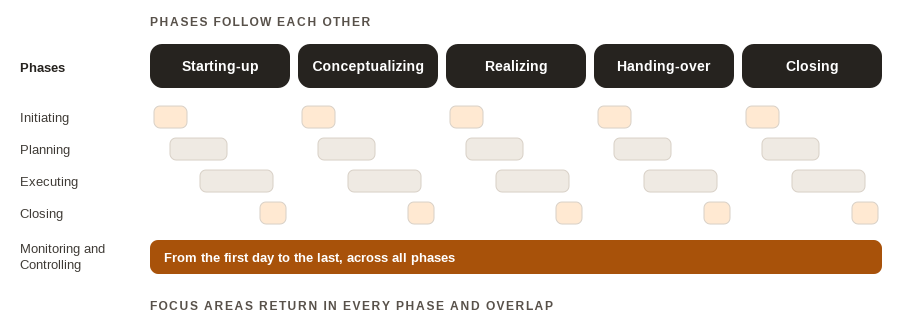
Project phases follow each other in time. Focus areas are kinds of work that return in every phase. That is why focus areas make a poor life cycle.
A project life cycle is "the series of phases that a project passes through from its start to its completion". Every project has a start and an end, and its phases follow each other. Focus areas do not:
- Monitoring and Controlling never stops. You track progress and handle changes from the first day to the last. It is not a stage you enter after Executing.
- Initiating and Closing return in every phase. PMBOK 8 even names the processes "Initiate Project or Phase" and "Close Project or Phase".
- Planning goes on. Detailed plans for the next phase are made while the current phase is running, and in an adaptive approach planning happens in every iteration.
- They overlap. In PMI's own words, the focus areas "often overlap and interact dynamically throughout the project life cycle".
The real risk is communication
A life cycle is first of all a communication tool. It is the picture your sponsor, your steering committee and your team carry in their heads.
When that picture says "Executing", stakeholders hear "planning is done". When it says "Monitoring and Controlling" after Executing, they hear that control starts late. And a steering committee that sees "Closing" at the end of the slide does not expect to close each phase properly. The names shape the expectations, and managing expectations is what project management is about.
Prefer to watch? In this video from 2021 I explain the same idea, still with the PMBOK® 6 term "process groups".
 How NOT to use the PMBOK process groups (2021)
What to use instead
In my courses I start with five simple steps that every project goes through: Start, Study, Do, Transfer, Stop. They show that a project is not that complicated.
Then I translate them into phase names that tell stakeholders what happens:
- Starting-up: the project is approved and set up.
- Conceptualizing: scope, approach and plans take shape.
- Realizing: the result is built or delivered.
- Handing-over: the result goes to its owners and users.
- Closing: the project is evaluated and formally closed.
Each sector fills in these phases its own way. A construction project and an ICT project do not look alike, but both pass through the same five steps. And yes, "Closing" is both a phase and a focus area. PMBOK 8 accepts that "some naming conventions may be the same". What matters is that the life cycle as a whole tells a story of phases, not of process categories.
Where focus areas do help
Focus areas are useful, as long as you use them for what they are:
- As a checklist per phase. At the start of each phase, ask: what do we need to initiate, plan, execute, monitor and close in this phase?
- As a learning structure. For courses and for the PMP® exam, the focus areas are a clear way to organise the 40 processes.
- As a shared language with PMI-trained colleagues. In an adaptive or hybrid project, they describe the cycle that every iteration goes through.
Keep the focus areas in your toolbox. Keep them off your life cycle.
Want your life cycle to tell the right story?
Pragmatic Project Management from the Field takes you from project start to close, with phase names and plans that work in practice, and up to 25 PDUs for your PMP® recertification. Setting standards for a whole organisation? The Project Management Office training helps you choose a life cycle and templates that every project can use.
Sources
- Project Management Institute (2025). A Guide to the Project Management Body of Knowledge (PMBOK® Guide), 8th edition. The Standard for Project Management, section 4.5 Project Management Focus Areas, p. 69–70; Glossary: project life cycle, Project Management Focus Areas, p. 271.
- Project Management Institute (2017). A Guide to the Project Management Body of Knowledge (PMBOK® Guide), 6th edition. Process groups, p. 23.
Steven Goeman is a PMP® and NLP Master Practitioner, guest professor at Thomas More, and has over 30 years of experience in and around projects. An earlier version of this article appeared on gaps.be.