Where to find your stakeholders
Stakeholders rarely introduce themselves. They show up late, often when a decision has already been made without them. This practical how-to shows where to look: twelve hiding places, from the sponsor's office and the client's site to the cc field of your mailbox.

You probably know the moment. The project is well under way, and someone you have never heard of walks into a meeting and asks why nobody consulted them. From then on you are not managing the project, you are repairing it.
Stakeholders rarely introduce themselves. You have to go and find them.
Long before you think about a stakeholder template, segmentation or prioritisation, identification starts with small things: asking, walking around and reading carefully.
A ferry, a new cabin, and a forgotten catering manager
Imagine a project to renovate the passenger cabin of a ferry. The sponsor is the fleet manager, the naval architect, the captain and the shipyard are on the list, and the kick-off goes well.
Four months later, the catering manager hears about the project for the first time. The new layout moves the café counter, halves the storage space and leaves no room to load supplies before the first crossing. She was never asked, and now she has a long list of objections.
Nobody did anything wrong on purpose. They simply looked for stakeholders in the obvious places only.
Who counts as a stakeholder?
A stakeholder is anyone who is affected by the project, or who can influence it. Two details make that definition practical:
- Stakeholders are real people. "Finance" or "the users" is a starting point, not a stakeholder. Behind every department is a person with a name and expectations.
- Impact or influence is enough. The catering manager has little formal influence on the project but feels a lot of its impact. A legal advisor who never sees the result can still stop it.
In PMBOK® 8, Identify Stakeholders is the first process in the Stakeholders Performance Domain, the same domain that now holds the communication processes. PMI describes it as "identifying project stakeholders regularly". That order makes sense, because you cannot engage people you have not found yet.
Twelve places where stakeholders hide
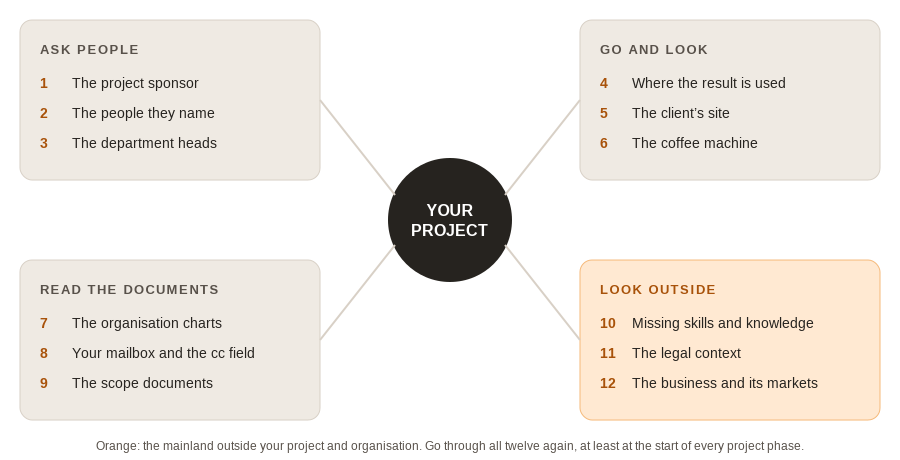
There is no standard list of stakeholders in a project: every project has its own. These twelve places help you build yours.
Ask people
- The project sponsor. As your real project client, the sponsor is the first stakeholder to approach, and therefore the first place to start. Ask who they think should be involved.
- The people the sponsor names. Go and see them, and ask them the same question. Every conversation gives you new names.
- The department heads. Once you know which departments are affected, ask each head who in their team should be involved.
On projects for an external client, start even earlier. The sales or bid team was involved before the project started, and they can already name a first set of stakeholders at the client.
On the ferry: the fleet manager names the captain. Asked the same question, the captain names the head of onboard services, and with that, the catering manager.
Go and look
- The place where the result will be used. Walk around and notice who works there. The people who will live with the result are often missing from the first list.
- The client's site. On projects for an external client, go to the client's site as soon as you can. That is where you meet the people who will use, maintain or be disturbed by what you deliver.
- The coffee machine. Informal talks about your project reveal who is worried, who is interested, and who has an opinion nobody asked for yet.
On the ferry: one early crossing shows the catering team loading supplies at six in the morning. At the café counter, which is the ferry's coffee machine, a deckhand asks whether anyone thought about passengers in wheelchairs.
Read the documents
- The organisation charts. Your own, and on client projects the client's as well. Identify every department the project touches, not only the one that asked for it.
- Your mailbox. Look carefully at who sends you e-mails about the project, and especially at who is in the cc field.
- The scope documents. Every process, system or business area in the scope has people behind it.
On the ferry: the organisation chart shows that onboard services report to a different department than the technical fleet. The safety officer turns out to be in cc of every e-mail about the cabin.
Look outside
- Missing skills and knowledge. What the organisation cannot do itself points to external stakeholders: suppliers, specialists, consultants.
- The legal context. Laws, permits and standards bring their own stakeholders, from authorities to inspection bodies and employee representatives.
- The business and its markets. Customers, partners and even competitors can be affected by your project, or influence it.
In my courses I often say:
"If you think your project is an island, make sure there are plenty of ferries to connect it to the mainland."
These last three places are about that mainland.
On the ferry: the seats and the café equipment come from suppliers, the external café operator has to approve the new layout, and the regular passengers will notice every week the ferry is out of service.
Prefer to watch? In this short video I walk through eleven of these hiding places.
 11 hiding places to look for project stakeholders
When are you done?
Never completely. New stakeholders appear when the project moves into a new project phase, when the organisation changes, or when the result comes closer to its users. That is why I go through the hiding places again, at least at the start of every project phase.
What comes after identification?
Identification is not only the start of your communication. The list you build also shows where influence and organisational politics play, which engagement tactics each stakeholder needs, and what has to change for whom, and how you will support that change.
- Turn a template into a working tool. Most organisations have a stakeholder template, and that is a good start. Shape it so that you can actually use it: to look up contact details in seconds, and as the first draft of your communication plan, with stakeholder segments that match your communication target groups. A register that only registers soon gathers dust.
- Prioritise, with an eye for informal networks. Not every stakeholder needs the same attention: some need to be involved closely, others only need to be kept informed. The organisation chart rarely shows who really carries weight, so look at informal networks and power relations too. Prioritisation deserves an article of its own.
Remember the catering manager. On the list from day one, she is the person who tells you how the cabin will really be used. Found in month four, she is the person who delays the reopening.
Before any of this is possible, first walk through these twelve places.
Want to find the right people in time?
In mentoring we look at your project together: who is on your list, who is missing, and how to approach the people you have not met yet. Prefer to learn with your team? Check our project management trainings.
Sources
- Project Management Institute (2025). A Guide to the Project Management Body of Knowledge (PMBOK® Guide), 8th edition. Section 2.5 Stakeholders Performance Domain, p. 67–70; 2.5.2 Processes, p. 70.
- Goeman, S. (2022). 11 hiding places to look for project stakeholders [Video]. About Project Management, YouTube.
Steven Goeman is a PMP® and NLP Master Practitioner, guest professor at Thomas More, and has over 30 years of experience in and around projects.