Project lessons learned: don't wait until the end.
Most teams collect lessons learned at project closure, when half of them are forgotten and none can still help. Here are the 5 steps to capture and use lessons while your project is still running, with real examples and a free register template.

Lessons learned get too little attention on most projects. Many project managers aren't sure when to capture them, or what to do with them afterwards. Training programmes usually mention them in passing, as the last step of project closure.
That is exactly the problem. By the end of a project, nobody remembers what happened in the first phase. And a lesson you only write down at the end can no longer help the project it came from.
What are project lessons learned?
The PMBOK® Guide defines lessons learned as:
"The knowledge gained during a project which shows how project events were addressed or should be addressed in the future for the purpose of improving future performance."
Three things in that definition matter in practice:
- Lessons are about what went well as much as about what went wrong.
- The point is not the event itself, but the action you took, and whether it worked.
- Lessons go beyond project management. Design choices, prototypes, testing, requirements that surfaced too late and the way you worked with contractors all teach you something.
Why lessons learned pay off
A lessons learned moment makes the team step back from the daily pressure. That distance is often where better ideas come from. It is also the basis of continuous improvement, for this project and for the next one.
And it is a communication tool. A lesson only has value when it reaches the people who need it, at the moment they need it: your team in the next phase, your steering committee when it decides, the project manager who starts a similar project next year.
A continuous process, not a closing ritual
The PMBOK® Guide treats lessons learned as part of managing project knowledge: work that happens while the project runs, not after it. The 8th edition (2025) keeps that process.
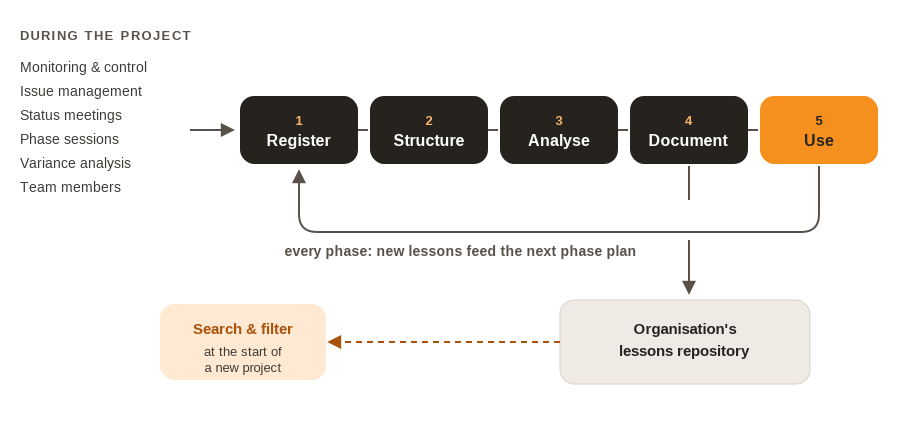
When you capture lessons continuously, you can apply them right away, in the same project. They come in through many channels:
- monitoring and controlling your project;
- issue management;
- status meetings;
- a short lessons learned session at the end of each phase;
- variance analysis;
- concerns raised by individual team members.
The 5 steps of lessons learned
The five steps of lessons learned are: register, structure, analyse, document and use. You repeat them in every phase, and before a new project starts, you search the lessons of earlier projects.
1. Register
Record each lesson in a lessons learned register: a spreadsheet, a database or your project software. Note the situation that triggered it and the action you took. Later, you check whether that action worked.
2. Structure
Make lessons easy to find with fixed categories: project type (engineering, construction, ICT…), phase, product complexity, size in time and budget, management area (scope, communication…), the departments involved, and any category your stakeholders need.
3. Analyse
Analyse the register at planned moments. Align this with your steering committee meetings, often monthly, so lessons become part of the governance conversation instead of an extra meeting.
4. Document
Right after the analysis, move the lessons to your organisation's central repository, often a lessons learned database, where current and future projects can search them.
5. Use
At the end of each phase, review the relevant lessons with your team. Recognise what went well and agree on what to keep doing. Then feed the lessons into the plan for the next phase.
Before you start: search
When a new project starts, search the repository for lessons from earlier projects. As it grows, the fixed categories let you filter, for example: ICT projects in the concept phase, with scope issues, on complex products using new technology.
Imagine starting your next project with the ten lessons that matter most for it already on the table.
Lessons learned examples
Here are three lessons from the register of a large construction project I managed, anonymised and written in the format of the free template below. Notice how each lesson describes the action, not only the event.
Example 1: from one-to-one talks to one team
- Phase · domain: Conceptualizing · Communication
- Type · impact: Negative · High
- What happened? Three months before an important board presentation, the concept was still not finished, and consensus was hard to reach.
- Plausible cause: The content was developed in separate one-to-one conversations with each expert.
- Action taken: Brought the experts together in a project management team, where they shaped the content together.
- Did the action work? Yes. The team worked well throughout the design phases.
- Recommendation for next time: When many experts shape one result, let them work on it together, not in separate conversations.
Example 2: the expert who was asked to lead
- Phase · domain: Realizing · Resources
- Type · impact: Negative · High
- What happened? During execution, team members kept acting as content experts instead of project leaders. They felt attacked when their earlier decisions were questioned, and coordination with other departments fell short.
- Plausible cause: The same people held both the expert role and the management role, and not everyone wanted to manage.
- Action taken: The project leader role was clearly defined and communicated.
- Did the action work? No. Clear roles on paper were not enough.
- Recommendation for next time: Separate the management responsibility from the expert role, and look for people with both the skills and the willingness to manage. Some people prefer to stay experts, and that is a valid career choice.
Example 3: one place for all project information
- Phase · domain: Realizing · Communication
- Type · impact: Negative · Medium
- What happened? Different parties used different document tools, and not everyone understood the document structure.
- Plausible cause: No single information system was agreed for the project.
- Action taken: People were trained in the tools.
- Did the action work? No. Some people still did not accept the tools.
- Recommendation for next time: Choose one information management system for the project, train people in both the tool and the document structure, and appoint someone to manage the documents: "the librarian".
Four tips
- Look at what went well. What worked is often the most useful lesson to repeat.
- Judge the action, not the event. Ask whether your intervention produced the result you wanted.
- Put lessons learned on the agenda of every status meeting, next to risks and scope. Not only when something went wrong.
- Share ownership. Let every stakeholder add lessons to the register. You spread the work, and you come to the analysis better prepared.
Bring lessons learned into your whole team?
In the Lessons Learned Workshop, your team learns to look back critically, find root causes and agree on concrete actions, on your own projects. Prefer support on your own project? Lessons learned are also a fixed step in every mentoring programme.
Sources
- Project Management Institute (2025). A Guide to the Project Management Body of Knowledge (PMBOK® Guide), 8th edition. Glossary: lessons learned, p. 269.
Steven Goeman is a PMP® and NLP Master Practitioner, guest professor at Thomas More, and has over 30 years of experience in and around projects. This article first appeared on gaps.be.