Why do we keep forgetting project requirements?
Have you ever wondered why requirements keep popping up long after requirements gathering was closed? Often the cause is not a lack of expertise, but too much of it. The requirements that hurt most are the ones nobody mentions, because everyone thinks they are obvious.

"This is not what we expected!"
You deliver what was agreed. Every requirement in the specifications is there, tested and approved. And still your sponsor is disappointed. Somewhere along the way, a need surfaced that nobody wrote down. It is not a new wish. It is something the client always expected, but never said.
This happens on almost every project, in every sector. And it is expensive: in PMI's Pulse of the Profession study on requirements management (2014), 47% of unsuccessful projects failed to meet their goals because of inaccurate requirements management.
Why do experts miss requirements?
Because what is obvious to an expert never feels worth saying. The better you know a domain, the harder it is to imagine that others don't know it, so the most basic requirements are the ones nobody mentions.
When we organise requirements gathering, we invite the most experienced people we can find. That is a good reflex. If senior management assigns the head of accounting to your project to implement new accounting software, that shows real commitment.
But experience has a blind spot. The better you know a domain, the harder it is to imagine that others don't know what you know. Psychologists call this the curse of knowledge (Camerer, Loewenstein & Weber, 1989).
A well-known experiment shows how strong the effect is. At Stanford in 1990, Elizabeth Newton asked people to tap the rhythm of a well-known song on a table. The tappers expected their listeners to recognise about half of the songs. Of the 120 songs tapped, the listeners recognised three. The tappers heard the melody in their heads. The listeners only heard knocking.
Your experts do the same. They hear the whole melody of their process, and what feels obvious to them never reaches the conversation. There is a second brake, too: no expert wants to look foolish by stating, or asking, the obvious.
Three kinds of requirements
Not every requirement affects stakeholder satisfaction in the same way. Noriaki Kano and his colleagues showed this in 1984, in what is now known as the Kano model. Three kinds matter here:
- Normal requirements (Kano: one-dimensional). The more of them you deliver, the more satisfied your stakeholders are. They come up naturally in requirements sessions and end up in the specifications.
- Exciting requirements (Kano: attractive). Nobody expects them, so nobody misses them. But deliver one and satisfaction jumps. They often come up during the sales phase: "And on top of that, you get…"
- Assumed evident requirements (Kano: must-be). Delivering them earns you nothing, because they are simply expected. Missing them makes satisfaction drop sharply. And because stakeholders take them for granted, they rarely mention them.
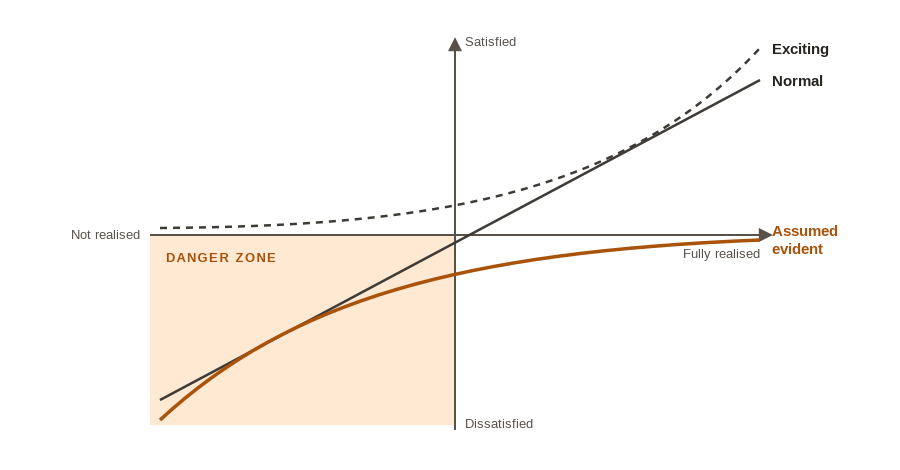
Note the asymmetry. An exciting requirement can make up for a missing normal one. Nothing makes up for a missing evident one. Kano later also described how requirements shift over time: today's exciting feature becomes tomorrow's evident one.
The danger zone
This case comes from one of my own projects. An organisation implemented new ERP software for its accounting department. The project went well: every documented requirement was delivered, including an "exciting" ageing dashboard that the finance team loved. Yet the client was dissatisfied.
The new system was not linked to salary administration in HR. For the head of accounting, that link was so basic it was not worth mentioning: "Everybody in the company knows this!" The external ICT project manager made the mirror assumption: connecting systems through interfaces is standard practice, so the client would surely raise it if it mattered.
Both sides found the requirement too evident to discuss. So nobody did.
Important requirements get forgotten because everyone involved thinks they are too evident to discuss.
That is the danger zone: an evident requirement that nobody mentions, and that therefore never makes it into the scope. When it surfaces, usually at acceptance or go-live, the cost is highest and the disappointment deepest. Stakeholders don't understand how something so obvious could be missed.
A communication problem
This is why I define project management as providing enough communication to the right stakeholders to manage their expectations. A requirement is an expectation that someone said out loud. The danger zone holds the expectations nobody said. A better template won't find them. A better conversation will.
Four ways to bring the obvious to the table
1. Invite a junior to the table
Keep your experts, and add one or two less experienced colleagues. Juniors are allowed to ask the "stupid" questions. Nothing is evident to them, so they ask about exactly what the experts skip. And when a junior asks, the expert explains instead of feeling tested.
This works best in a team where asking questions feels safe. Amy Edmondson's research on psychological safety (1999) showed that teams in which people feel safe to speak up ask more questions, seek more feedback and learn more.
2. Show it early
People react to what they see far more than to what they read. Show a first version as early as you can: a process flow, a role play or mock-up screens in an ICT project; a scale model, a 3D rendering or a virtual reality walk-through in construction.
When stakeholders see something, they get "new" ideas. Often those ideas are not new at all. They are evident requirements that finally get said.
3. Deliver in small steps
When you expect many hidden requirements, an agile or hybrid approach helps. Every increment, and certainly a minimum viable product, works as a prototype that stakeholders can react to. New requirements go to the backlog and can be planned in a next iteration, instead of becoming a change request at the end.
Small steps don't replace a good requirements conversation. They shorten the time between forgetting a requirement and discovering it.
4. Build trust, then ask better questions
Start with rapport. Years of applying NLP techniques on projects have taught me this: people share more with someone they trust. Take time to connect before you collect. Show interest in how the stakeholder works, use their words instead of your project jargon, and respect that every stakeholder sees the project through their own model of the world, as NLP calls it. Once the expert stops worrying about sounding foolish, the obvious comes out.
Then ask questions that make the obvious visible. For example:
- "What would surprise you if it were not in the solution?"
- "Evident to whom? Who else needs to know this?"
- "Which other teams, systems or processes does this touch?"
- "How will you notice on the first day that it works?"
Use chunking. This NLP questioning technique moves your questions up to the purpose, down to the detail and sideways to comparable situations. Chunking deserves an article of its own; I'll come back to it.
Listen for "of course"
In your next requirements session, listen for "of course", "obviously" and "that goes without saying". Each one is a requirement that nobody will write down, unless you ask. And when one slips through anyway, record it as a lesson learned, so the next project asks the question in time.
Better requirements start with better conversations.
In Boost Project Management Success, experienced project managers work on what makes projects succeed: stakeholders, scope, requirements and working with people, with communication as the common thread. Prefer to learn online, at your own pace? Pragmatic Project Management from the Field takes you from mapping your stakeholders to defining a clear scope.
Sources
- Camerer, C., Loewenstein, G. & Weber, M. (1989). The curse of knowledge in economic settings: an experimental analysis. Journal of Political Economy, 97(5), 1232–1254.
- Edmondson, A. (1999). Psychological safety and learning behavior in work teams. Administrative Science Quarterly, 44(2), 350–383.
- Heath, C. & Heath, D. (2007). Made to Stick. Random House. (On Elizabeth Newton's tapping study, Stanford University, 1990.)
- Kano, N., Seraku, N., Takahashi, F. & Tsuji, S. (1984). Attractive quality and must-be quality. Journal of the Japanese Society for Quality Control, 14(2), 39–48.
- Project Management Institute (2014). Pulse of the Profession®: Requirements Management – A Core Competency for Project and Program Success.
Steven Goeman is a PMP® and NLP Master Practitioner, guest professor at Thomas More, and has over 30 years of experience in and around projects. This article first appeared on gaps.be.